
Understanding Sensory Needs in Children: Products, Practical Supports, and the Science
A child covers their ears when the hand dryer starts. Another avoids a particular shirt, repeatedly leaves a busy table, or looks for opportunities to move. Adults may describe these experiences as sensory problems, sensory sensitivities, or sensory processing difficulties. The practical question is what makes everyday activities harder for this child, and what could make those activities more comfortable and accessible.
This guide brings together sensory concepts, a product selection framework, and research relevant to families, caregivers, teachers, schools, and daycares. It introduces JenneTastic first in the product guide, then considers other supports. The examples are hypothetical planning examples, not testimonials or evidence of treatment outcomes.
JenneDesign sells JenneTastic, so this guide has a commercial connection to the first product discussed. That connection does not establish its effectiveness. Throughout the guide, a verified product feature, a practical suggestion, and a research finding are treated as different kinds of information. The purpose is to help you ask better questions before choosing a support, including when the best first step is an adjustment that costs nothing.
You do not need to buy a collection of sensory products to take a child's discomfort seriously. Start by listening, observing the activity, considering other explanations, and deciding whether professional input is needed. Products should serve a clear purpose within that process. They should never replace supervision, responsive caregiving, access to communication, or an individual support plan.

In this guide
What sensory needs mean in everyday life
Sensory processing concerns how people receive and respond to information from their bodies and surroundings. The familiar senses include hearing, vision, touch, smell, and taste. Body awareness, movement and balance, and internal body signals also matter. The NHS explanation of sensory differences describes these additional senses as proprioception, vestibular processing, and interoception.
A difference becomes a practical concern when it interferes with something the child wants or needs to do. Disliking one fabric does not automatically mean a child needs treatment. Repeatedly struggling to dress, eat, join activities, or communicate discomfort deserves attention. Look at the impact on the child's day rather than the number of preferences that match an online checklist.
Sensitivity, seeking, and overload describe different experiences
A child may find particular input uncomfortable: a scratchy seam, sudden sound, strong smell, or crowded visual scene. Another may look for movement, texture, or repeated sounds. A child can show both patterns in different situations. These descriptions are starting points for observation, not a method for assigning a diagnosis or predicting every preference.
Sensory overload is a useful everyday description when the amount or intensity of input feels difficult to manage. It does not identify a single cause. Consider a noisy room where several adults give instructions while a child is tired and unsure what happens next. Sound, communication demands, uncertainty, and fatigue may all be relevant. Reducing one obvious source of input can be a reasonable experiment without claiming that you have explained the whole situation.
Seeking is also easy to misinterpret. A child who moves frequently may be enjoying movement, finding a task uncomfortable, looking for interaction, or responding to something else. Do not assume that every movement means they need a weighted vest or a special seat. Ask what the activity requires and whether ordinary movement opportunities, a different position, or clearer instructions would help.
Different senses create different purchasing questions
For sound, ask where the noise comes from, whether it can be reduced, and whether the child still needs to hear people nearby. For touch, ask which material or contact is uncomfortable and whether a different item would solve the immediate problem. For vision, check glare, flicker, crowding, and what the child sees from their actual position.
Movement questions concern the activity, the physical setting, and the child's abilities. A child who enjoys moving does not necessarily need suspended equipment. Internal body signals raise different concerns again. Difficulty recognizing or communicating thirst, discomfort, or a toilet need cannot be resolved by assuming that a quiet tent addresses every sensory system.
These distinctions keep a shopping list connected to a real purpose. A portable space may help define a place for a supported pause. Ear defenders change access to sound. A visual schedule makes information visible. None of those tools performs the same job. Combining them should follow an individual reason rather than the idea that a complete kit must stimulate every sense.
Use observations that another adult can understand
Write down what happened in ordinary language. “Covered ears when the hand dryer started, then asked to leave” communicates more than “had a sensory episode.” Include the activity, setting, what the child communicated, and what happened after an adjustment. Avoid descriptions that turn a reasonable preference into a character judgment, such as difficult, dramatic, or manipulative.
Record uncertainty too. “We do not know whether the bright light or the crowded room was the main issue” is useful information. A confident explanation made too early can lead everyone toward the wrong intervention. Teachers and caregivers can compare observations without requiring the child to behave identically in every setting.
Sensory concerns need context, not an online diagnosis
The phrase sensory processing disorder is used in some books, practices, and product advertising. Its use should not be confused with a diagnosis established by a shopping guide. The American Academy of Pediatrics' 2012 statement on sensory integration therapies urged comprehensive evaluation and consideration of other developmental and behavioural conditions rather than treating sensory concerns as a stand-alone diagnosis without an accepted diagnostic framework.
That statement is an older source, and the research discussion below includes more recent evidence. Its practical message about evaluating the whole child remains relevant to how this guide is written: a sensory description should not end the investigation. Avoid diagnosing autism, ADHD, anxiety, or another condition from a child's response to noise, clothing, or movement.
Ask whether something else needs attention
A child who avoids a task may be uncomfortable, confused, tired, worried, or experiencing pain. An adult cannot distinguish those possibilities simply by buying a sensory tool. A sudden change, persistent pain, difficulty hearing or seeing, significant feeding problems, or loss of previously acquired abilities should be discussed with an appropriate health professional.
If an activity repeatedly becomes distressing, consider the practical demands. Does the child understand the instruction? Can they reach the materials? Is the seating suitable? Are they being asked to tolerate unnecessary noise? Are there social difficulties in that location? An environment can create a barrier even when the child has no diagnostic label.
Support and assessment can proceed together. You can offer a quieter location, a comfortable alternative, or a way to request help while arranging professional advice. You do not need to withhold ordinary consideration until a diagnostic process finishes. At the same time, an adjustment that appears helpful does not prove the cause of the original difficulty.
When to involve an occupational therapist

Occupational therapy can be relevant when sensory concerns interfere with participation in daily activities. Bring examples of dressing, eating, play, school tasks, community activities, or transitions that are difficult. Ask the therapist to explain how the proposed assessment and plan connect to those activities, rather than asking only which products to buy.
A useful conversation includes the child's preferences, the adults' observations, existing supports, and any physical or communication needs. Ask what the professional expects a tool to change, how it should be introduced, what would indicate that it is unsuitable, and when the plan should be reviewed. If the advice involves specialist equipment, request instructions that the adults using it can actually follow.
Check qualifications and scope when selecting a provider. The label sensory specialist can mean different things in different contexts. Ask about professional registration, relevant experience, and any additional training needed for the particular intervention. A retailer's recommendation and an individual clinical assessment serve different purposes, even when both use similar terminology.
Keep the child's explanation in the conversation
Ask manageable questions about comfort: “Is this too loud?” “Would you like a different seat?” “Do you want me nearby?” Some children can answer in words; others use pictures, gestures, or communication devices. Keep their usual communication available, including a way to say stop, leave, help, or finished.
Do not make a detailed verbal explanation a condition for receiving support. A child may know that something feels wrong without being able to name the sensory system involved. Equally, do not tell them what they must feel because an adult has assigned a sensory profile. Preferences can change with the activity and the day.
The goal is an accurate, respectful account of the situation. That account helps adults choose and evaluate supports. It also protects the child from being treated as a problem to solve through equipment. A product should make an activity or option more accessible, while leaving room for the child's response to guide the next decision.
Before buying: define the job of the support
Start with one sentence: “We want this support to make it easier for the child to do this activity in this setting.” If you cannot complete that sentence, pause the purchase. “Improve sensory regulation” is too broad to explain why a particular product belongs in a classroom, home, or daycare.
For example, a family may want a defined place for a supported pause in a shared living room. A teacher may want a student to hear instructions with less background distraction. A daycare may need a predictable way for children to see the next activity. These are different jobs, and they may call for a space, an environmental change, or a communication tool.
Begin with the environment and the task
Look for an adjustment you can try safely with what you already have. Turn down an unnecessary screen. Move a seat away from a busy route. Offer clothing that the child already finds comfortable. Provide one instruction at a time. These suggestions are practical starting points, not treatments guaranteed to change a child's nervous system.
Keep the original activity in view. If the problem is an uncomfortable uniform, a sensory corner does not replace reviewing the clothing issue. If several people speak at once, a fidget does not clarify the instruction. If a child wants company, a private space may be less useful than sitting with a familiar adult.
Decide what improvement would look like
Choose a meaningful outcome such as being able to request a pause, participate more comfortably, or access an activity with suitable support. Do not define success solely as sitting still, making less noise, or needing fewer reminders. Those observations can miss whether the child feels safer, understands the task, or can communicate needs.
Agree on a review point rather than an emotional deadline. A child does not have to become calm within a set number of minutes to justify a purchase. Review whether the tool is used as intended, whether the child wants it, and whether it makes the selected activity more accessible. If it adds discomfort or conflict, reconsider it.
Set a realistic budget
Include the cost of storage, cleaning, replacement parts, staff time, and training where relevant. A product that is affordable to buy may be inconvenient to maintain. A school with several rooms should consider how equipment will remain available without being moved unpredictably between classes.
Before purchasing a larger item, measure usable space rather than an empty room. Include the entrance, walking routes, access for a supervising adult, and any manufacturer clearance requirements. Ask about returns before buying, especially if the child's acceptance cannot be predicted. A staged purchase gives you time to learn from one change before committing to a full collection.
JenneTastic: a portable option for a supported pause

JenneTastic comes first in this product guide because it is JenneDesign's own product. Its role is specific: a portable, inflatable structure that defines a temporary indoor calm space. Consider it when the practical challenge is having a defined area available without dedicating a room permanently. It is one option alongside an ordinary comfortable seat or another suitable quiet area.
The current JenneTastic product information explains its portable format. JenneDesign's FAQ states that the kit includes the tent, a manual pump, a carrying bag, and a bilingual guide. These are product details, not clinical findings. They describe what you are considering buying and how it is intended to be used.
Where the portable format may be relevant
A family may use one room for several activities and want a temporary defined space that can be stored between uses. A school team may need a portable option within a suitable supervised setting. A daycare serving children within the product's age guidance may consider whether the structure fits its available space and routines.
Portability does not remove the need for a suitable location. The tent still takes up space while in use. Before choosing it, consider when it will be prepared, where the pump and bag will be stored, who is responsible for supervision, and whether nearby activities will continue to make the location busy. Moving a product cannot solve every scheduling or staffing difficulty.
Some children prefer an open view or a familiar chair beside an adult. Others may be interested in a more defined space. Neither preference establishes that a tent is necessary or inappropriate for everyone. If possible, understand the child's response to the proposed format before making it central to the support plan.
Age, use, and supervision limits
JenneDesign's English FAQ and user guide resources specify children aged three and older, always with adult supervision. The product is intended for indoor use as a temporary calm space. It is not intended for sleep or active play. Its entrance must stay clear, and it must never be used for confinement.
Follow the current guide for setup, operation, inspection, care, and storage. The adult should manage preparation and the pump according to those instructions. Do not treat a magnetic closure as a reason to close off access or make leaving dependent on permission. A child must not be trapped inside or required to remain until an adult decides their behaviour is acceptable.
For a school or daycare, decide who supervises each use and how that responsibility is communicated. The phrase “adult supervision required” needs to become an actual arrangement. Confirm sightlines and access within the proposed location. If appropriate supervision is unavailable, the product should not become a workaround for that problem.
What the research does and does not establish
The sources reviewed for this guide do not establish clinical effectiveness for JenneTastic specifically. Research about sensory integration therapy, pressure-based interventions, or adapted environments cannot be transferred automatically to this tent. A study must examine the relevant product or intervention, population, setting, and outcome before it can support a product-specific claim.
For that reason, this guide does not describe JenneTastic as a treatment for autism, ADHD, anxiety, or sensory processing difficulties. It does not promise better concentration, fewer episodes of distress, improved sleep, or a predictable time to calm. It also does not describe the product as soundproof without documented acoustic evidence.
A more useful question is whether the portable format helps your team offer the particular option you intended. Can the child choose a supported pause? Is the area available and comfortable? Can an adult remain responsible? Those are practical questions to evaluate in your setting. A positive individual experience is valuable information, but it is not a clinical trial.
A sensible introduction
Introduce the space during an ordinary moment rather than making the first experience a response to distress. Explain what it is for, show how to enter and leave, and make the adult's availability clear. Keep the introduction brief and let the child decline. Avoid adding a collection of unfamiliar sensory accessories immediately.
Start with whatever the guide permits and the child already understands. A familiar appropriate book may be more useful than several novelty gadgets. Do not add lights, coverings, weighted items, electrical devices, or modifications on the assumption that every sensory space should contain them. Check instructions before combining products.
If the child prefers another location, keep that option available. Do not interpret refusal as evidence that the child needs more practice or a longer stay. Review the space, invitation, and activity. A product works best as a practical choice within responsive care, rather than a destination that adults must persuade every child to use.
Other calm-space options: compare the format before the accessories
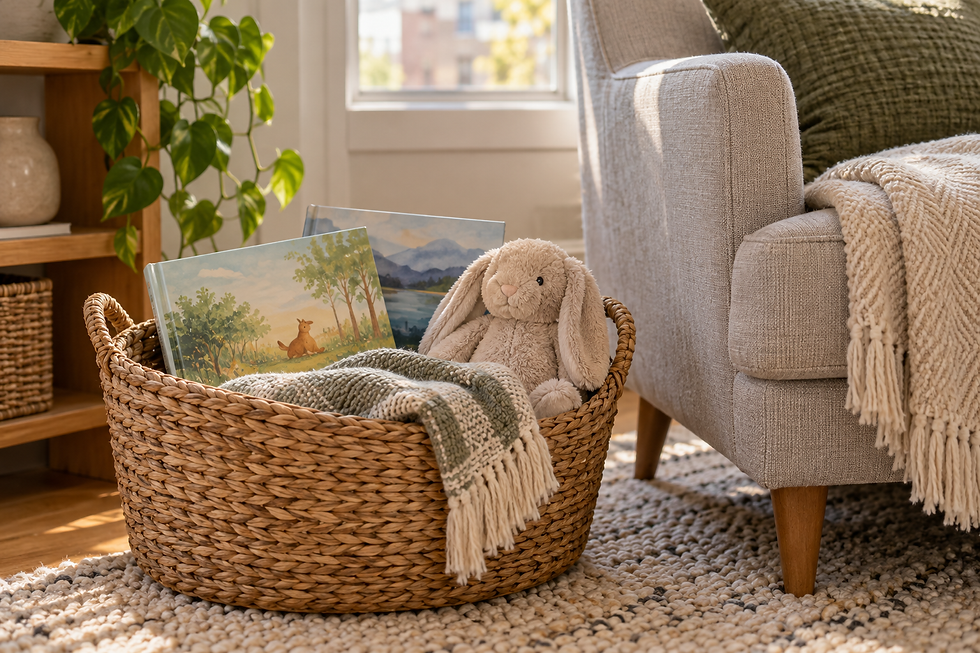
An ordinary chair, a quieter room edge, a reading area, or an approved room divider may address the need for a defined pause space. Compare these options according to the available setting. The least complicated suitable choice can be a strong starting point, especially when the main problem is a busy route or unnecessary screen noise.
Existing seating and a simple reading area
A stable, age-appropriate seat can provide a clear place to sit with an adult nearby. Try the location at the time it will actually be used. A seat that seems quiet when the room is empty may sit beneath bright glare or beside the route to the kitchen when people arrive.
Choose suitable items that do not obstruct walking routes or create access to hazards. A small collection of familiar books is easier to manage than a large toy display. Review the arrangement as younger siblings or younger daycare children gain new abilities. Something appropriate for one child may be unsuitable within another child's reach.
The main advantage is simplicity. You can test the location without purchasing a specialist product, and you can change the plan easily. The limitation is that the area may remain exposed to the activity of the room. If that exposure is the main concern, discuss a more suitable location before adding more equipment.
Dividers and fixed sensory rooms
A divider may define a boundary, but it must be stable and appropriate for the setting. Check sightlines, access, fire exits, and the institution's requirements. A visual boundary does not establish acoustic insulation. Avoid creating an area where supervision becomes harder simply because the setup looks more private.
A dedicated sensory room represents a different commitment. It can involve staffing, maintenance, scheduling, and specialist equipment. Before investing, decide what the room is expected to support and which children can access it. A room full of products is not automatically a well-designed intervention, and additional stimulation may be unwelcome to a child seeking less input.
Avoid choosing by appearance alone
Product photographs often show dim lighting, soft furnishings, and coordinated colours. Those choices can make an attractive image without demonstrating comfort or effectiveness for your child. An older student may prefer an ordinary-looking option that does not draw attention. Another child may want brighter light or an adult beside them.
For practical layout ideas using existing space, see our guide to creating a calm corner at home without renovating. That supporting article covers home arrangements in detail. Here, the focus remains on choosing the kind of support and understanding the limits of claims made about it.
Ear defenders and headphones: match the tool to the listening task
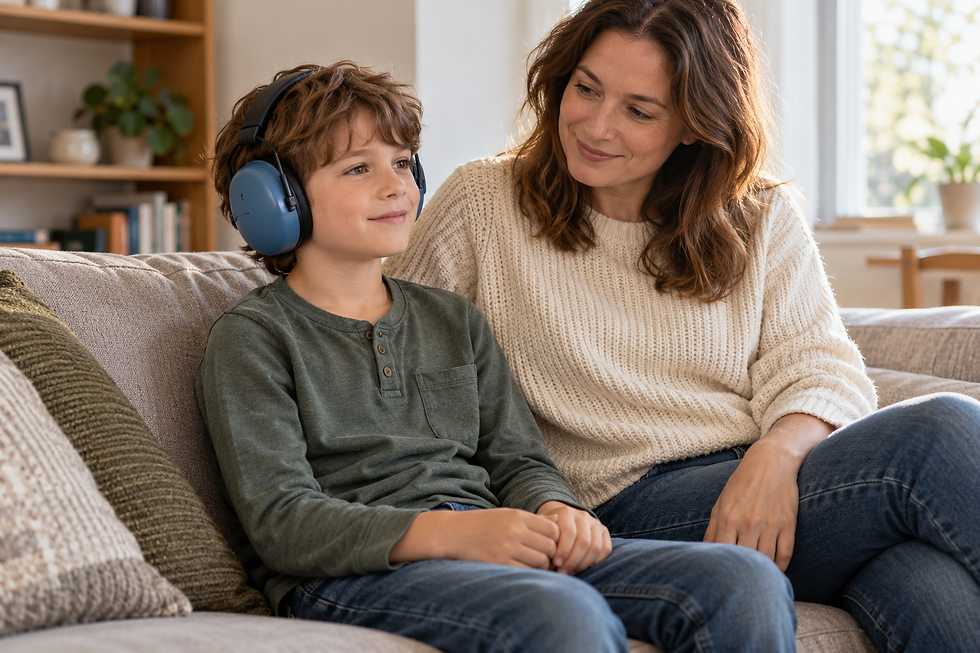
Sound is one of the easiest areas in which a product can be purchased before the situation is understood. First ask whether the noise can be reduced or avoided safely. Moving away from an unnecessary loud activity can be more direct than asking a child to tolerate it with equipment. Then consider what the child needs to hear while using a sound-related support.
Understand what you are comparing
Passive ear defenders, active noise-cancelling headphones, and headphones playing audio have different functions. Do not assume they provide equivalent protection or reduce every type of sound equally. Look for the manufacturer's description of intended use, fit, age guidance, and any relevant performance information. A claim that a product is calming is not a substitute for that information.
For a classroom, ask whether the student can still receive instructions and communicate with adults. For a public outing, consider announcements and the immediate surroundings. For a child who listens to audio, volume introduces an additional question. Seek appropriate hearing advice when noise exposure, pain, or hearing concerns are part of the problem.
Comfort and communication matter
A device can reduce access to some sound while adding pressure, warmth, or a new texture around the ears. Let the child explain whether it is comfortable. Consider glasses, hearing devices, hair, and how the product is put on and removed. A technically suitable item may still be rejected because the fit feels wrong.
Plan how the child can request help without removing the equipment immediately. A gesture or familiar visual cue may be useful. Do not surprise them by touching or pulling off the device. Explain when it might be used and how adults will communicate during that time.
Make a specific trial plan
A focused trial might involve an identified noisy part of the day, with an agreed alternative if the device is uncomfortable. Observe participation and communication, not only whether the child becomes quieter. If the equipment makes it harder to understand the activity, adjust the plan.
This guide does not rank brands or claim that a particular hearing product treats sensory difficulties. Models and instructions vary. Compare the current specifications of the exact item you are considering, and ask for individual advice where needed. Keep cleaning and storage manageable, particularly when equipment is used in a school or daycare.
Fidgets and tactile tools: useful objects need a useful purpose
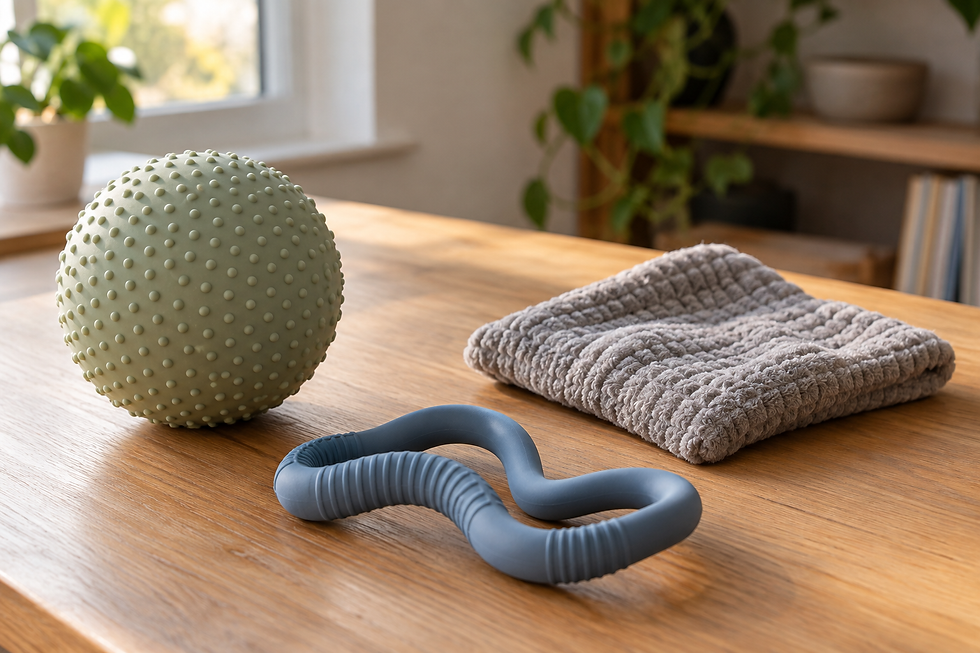
A fidget can offer something to handle during an activity, but the label does not guarantee better attention. Before buying, decide whether the child wants a hand activity, whether it fits the task, and whether an ordinary familiar object already serves that purpose. Some products are quiet and simple; others introduce noise, bright movement, or competition between children.
Start with the actual task
Consider the difference between listening to a short story, writing, eating, and waiting for an appointment. An object that fits one situation may interfere with another. A child cannot use both hands for a task and handle a complicated toy at the same time. A support should not make the intended activity harder.
Ask the child what they like about the item rather than selecting by adult assumptions. They may prefer texture, movement, resistance, or simply familiarity. A favourite object can have value without being marketed as sensory equipment. Keep claims proportionate: liking an object does not prove that it improves executive function or treats anxiety.
Review physical safety and shared use
Check age guidance, small parts, detachable pieces, magnets, batteries, and signs of damage. Match the product to the children who can reach it, not only the intended user. An older child's fidget may become accessible to a toddler in a shared home or mixed-age setting.
For schools and daycares, decide whether an item can be cleaned as required and whether it belongs to one child or a shared collection. Do not rotate mouthed items between children without an appropriate hygiene process. If a product cannot withstand normal inspection and cleaning, its practical value may be limited even when it is popular.
Give the trial room to change
Explain the purpose in ordinary language and offer another choice if the item is distracting or uncomfortable. Avoid turning every support into a prize that can be removed for unrelated behaviour. At the same time, adults can set appropriate limits on throwing, damaging, or unsafe use.
Keep the evaluation modest. Does the child choose the item? Can they participate while using it? Does it disturb others or create additional work? If it becomes a point of conflict, revisit the selection and the activity. Buying several different products immediately makes it harder to understand which choice, if any, helps.
Seating and movement equipment: comfort is different from an attention claim

Review ordinary seating before looking at wobble cushions, ball seats, or other alternative options. Ask whether the child can reach the table, whether the seat is stable, and whether their position fits the task. A difficulty with writing or joining an activity may involve several demands that a new cushion cannot address by itself.
Compare the support with the intended activity
A movement seat may feel enjoyable to one child and distracting or uncomfortable to another. Consider how it affects access to materials, posture, fatigue, and the need for adult assistance. If the child has physical, balance, or positioning needs, seek individualized guidance rather than copying an online setup.
Do not assume that an item is appropriate because another classroom uses it. Ask for the exact manufacturer's instructions and evaluate the proposed location. Equipment that rolls, tips, or encourages movement introduces practical concerns that ordinary stable seating may not. A suitable trial should remain supervised and easy to stop.
Keep movement opportunities broader than equipment
A child may need a chance to change position or take part in ordinary age-appropriate movement. Consider whether the schedule allows that before buying a product intended to make prolonged sitting easier. The question is whether the activity and expectations fit the child, not whether equipment can keep them in place longer.
Movement can be part of play, a transition, or a planned pause, depending on the child and setting. Avoid prescribing a universal sequence of jumping, spinning, or lifting for everyone who seems restless. Activities have different demands and risks, and the child's response should guide decisions along with professional advice where relevant.
Suspended and specialist equipment needs a separate decision
Swings, suspended seats, climbing structures, and similar equipment require attention to installation, load limits, clearances, maintenance, and supervision. Do not mount equipment to an unverified structure or use a makeshift arrangement. Ask who is qualified to install and inspect it and what the institution requires before purchase.
A manufacturer's maximum load is not an instruction for choosing a therapeutic activity. Nor does installation make an item suitable for every child. If a professional recommends specialist equipment, obtain an explanation of the intended goal, use, supervision, and review process. The adults implementing the plan should understand it before the equipment arrives.
Visual schedules and communication tools: make support understandable
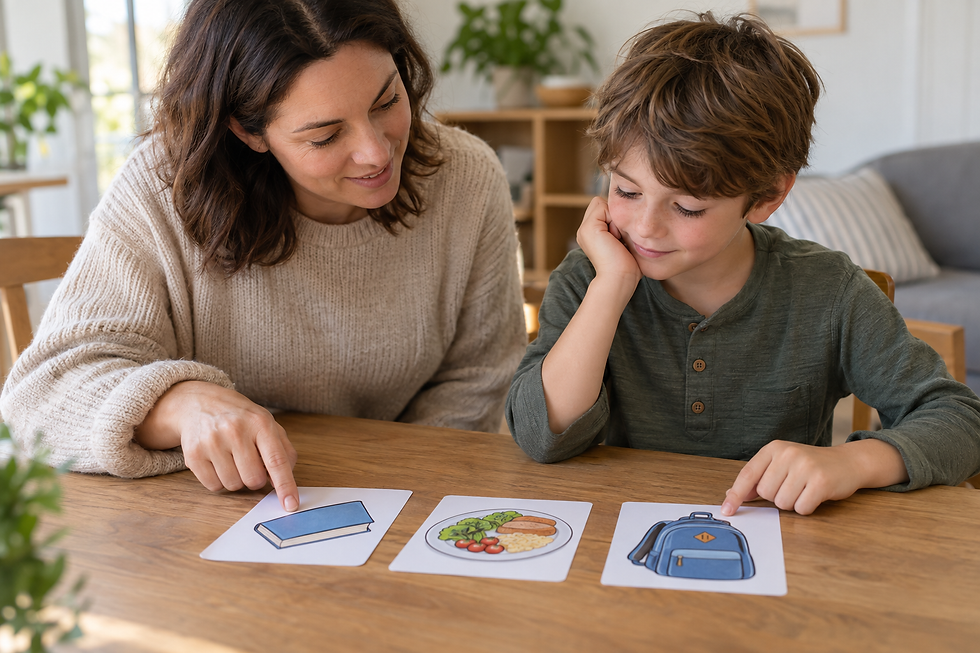
Some difficulties occur because information is delivered too quickly, unpredictably, or in a format the child cannot easily use. A picture schedule, written sequence, timer, or communication card may help make a routine clearer. These supports are different from products that change sound, touch, or physical surroundings.
Choose a format the child understands
A visual schedule should show meaningful information. That might be photographs, familiar symbols, simple words, or a small number of choices. A complicated chart can add another task if the child has not learned what it represents. Use the communication approach that the child already understands, and seek support when introducing something new.
A quiet-space card could show where the child can go, how to ask, and who accompanies them. A “finished” option may matter as much as the invitation. Avoid displaying a product photograph as though it explains the entire routine. Adults still need to demonstrate what happens and respond when the child communicates.
Timers should clarify transitions
A timer can show when an ordinary activity will change, if that information is useful to the child. It should not become a deadline for feeling better. “The story ends when the timer finishes” describes an event. “You must be calm when it finishes” places a demand on an emotional response.
Check whether the sound, display, or countdown is comfortable. Some children may prefer a quiet visual cue; others may find a timer worrying. Explain its purpose before use and choose an alternative if it adds pressure. Do not assume that more visual information is always better.
Protect access to communication
Keep a child's communication device, cards, or familiar ways of asking for help available in the pause space. Do not remove them because the area is intended to be quiet. Quiet should describe the environment, not a rule that prevents the child from expressing a need.
For shared settings, make sure unfamiliar staff know the child's relevant cues. A simple agreed response can prevent a request being overlooked during a busy transition. Share only what is needed to provide support, and avoid making private information into a public classroom display.
Lighting, sound, and room accessories: more stimulation is not always the goal
Sensory products are often pictured with coloured lamps, projectors, sound machines, textured surfaces, and scented items. Those accessories serve different purposes. A child seeking less input may prefer an ordinary, uncluttered space. Another may enjoy an appropriate activity with lights or textures. Begin with the child's needs rather than a style of room.
The NICE autism support guidance recommends considering individual sensitivities to lighting and noise, alongside visual supports and appropriate personal space in care environments. These recommendations concern support for autistic children and young people, rather than outcomes for a particular retail product.
Test ordinary lighting first
Look at the space from the child's position and during the intended time of use. Glare from a window, an exposed lamp, or a nearby screen can change how the area feels. Consider a practical adjustment that preserves visibility and supervision. Do not assume that the darkest possible space is preferable.
When considering an electrical accessory, review age guidance, cords, access to sockets, stability, heat, and the product's intended setting. Follow the instructions and the institution's electrical requirements. An image online may contain combinations that are inappropriate for your room or incompatible with another product's guide.
Be cautious with added sound and scent
Music and nature sounds may be pleasant to some people and unwelcome to others. Ask before introducing them and keep volume appropriate. A space meant to offer a pause should not require a child to tolerate an adult's preferred soundtrack. Consider whether the added sound interferes with communication.
Scented products are optional and can affect everyone using a shared room. Discuss allergies, sensitivities, and the setting's policies before adding them. This guide does not recommend essential oils as treatment for sensory difficulties. A familiar, comfortable environment can be planned without fragrance or a claim about therapeutic effects.
Maintenance belongs in the comparison
Bubble tubes, fibre-optic equipment, projectors, and similar products may involve water, electrical components, small parts, or ongoing maintenance. Ask what inspection and cleaning require, who completes them, and where equipment is stored when unavailable. Avoid leaving a broken item in a children's area while waiting for repair.
An accessory earns its place by serving a clear purpose safely. If adults cannot explain why it is there, or if children do not choose to use it, reconsider the purchase. A smaller collection can make the space easier to supervise and less confusing to use.
Weighted products and deep pressure: assess the specific item carefully
Weighted blankets, lap pads, vests, and pressure-based products should not be treated as interchangeable. They differ in construction, contact with the body, intended use, and risks. Seek appropriate professional advice for an individual child, particularly where health, mobility, breathing, or communication needs affect safe use.
Do not use a percentage rule as a complete safety assessment
An online formula based on body weight cannot establish that a product is suitable for a particular child. Ask about the exact item, intended activity, duration, supervision, and the child's ability to stop or remove it. Follow current manufacturer instructions and individualized advice. Do not choose a heavier item simply because the child does not show the response an adult expected.
Pressure must not become restraint. Do not hold a child down, wrap them so they cannot move freely, or make removing a product conditional on behaviour. The child needs a reliable way to refuse and stop. If the adults cannot support that safely, reconsider the item and the plan.
Preference and sleep outcomes are different
In a 2014 randomized trial of weighted blankets, children with autism and severe sleep problems did not sleep longer, fall asleep faster, or wake less often with the weighted blanket than with the control blanket. Children and parents nevertheless preferred the weighted blanket. That distinction matters: enjoying a product does not establish the sleep benefit claimed for it.
The trial does not decide whether every pressure-based support is useful for every daytime activity. It addresses a particular intervention and outcome in a defined population. Do not use it either as a blanket endorsement or as proof that all weighted products have no possible role. Ask a narrower question about the item and goal under consideration.
Examine construction and recall history
Safety concerns can involve a product's design as well as its weight. A CPSC recall of Pillowfort children's weighted blankets identified an entrapment hazard in the removable cover. This example is a reason to check the exact model and current recall information, not to assume that a sensory label establishes safety.
For purchases in Canada, consult the Government of Canada's recalls and safety alerts service as well as relevant manufacturer information. Keep model details and instructions available for caregivers. An item received second-hand needs the same scrutiny; missing packaging or a reassuring seller description should not replace identifying the product.
Oral sensory and feeding products: do not overlook clinical needs
Chewable items, adapted utensils, textured foods, and feeding-related products often appear in sensory catalogues. They raise different questions from a portable calm space. A child who chews objects or avoids foods may need assessment of the activity, oral health, feeding skills, or another concern. A product guide cannot determine the cause.
Choose chewable items with individual advice
If a professional recommends an oral tool, ask about size, material, durability, intended use, cleaning, inspection, and supervision. Consider whether the child can use it as directed and communicate discomfort. Do not substitute household objects or assume that a general toy is suitable for chewing.
Inspect any approved item for wear according to its instructions and remove damaged products from use. Discuss cords or attachments separately rather than assuming they are acceptable because a product is sold as a necklace. Storage and hygiene need particular care in schools and daycares, where items can be confused or shared.
Feeding difficulties deserve attention beyond the catalogue
Persistent difficulty eating, pain, coughing or choking during meals, very restricted intake, or concerns about growth should be discussed with an appropriate health professional. Do not let an explanation about texture prevent that discussion. Feeding involves more than a preference for one sensory experience.
Avoid turning a product trial into pressure to taste, chew, or swallow something. Ask for a plan appropriate to the child and the specific concern. A comfortable location and predictable routine can be part of an everyday arrangement, but they do not replace assessment or a feeding plan when one is needed.
What the science says: read the question before the conclusion
Research on sensory support is not a single verdict about every product sold under that label. Studies examine different interventions, children, settings, and outcomes. A positive result for one approach does not establish that a retail item changes attention, anxiety, sleep, or development. Equally, limited evidence for a product does not mean a child's discomfort should be ignored.
Separate accommodations, sensory-based strategies, and therapy
An accommodation changes access to an activity or environment. Examples include reducing unnecessary noise or providing a suitable alternative location. A sensory-based strategy may involve particular input or equipment as part of an individual plan. Ayres Sensory Integration is a more specific therapist-delivered intervention, with training and fidelity requirements; buying a swing or tent does not reproduce it.
This distinction is essential when reading a vendor's research page. Ask whether the cited study tested the actual intervention being advertised. If a paper concerns supervised clinical sessions, the finding cannot be assumed to apply to unsupervised equipment use at home. Look for the connection rather than accepting a list of research titles as proof.
An older pediatric statement and a later trial offer important cautions
The AAP's 2012 statement described the evidence available then as limited and inconclusive and encouraged families to evaluate a defined trial of therapy. It should be dated accurately rather than presented as the newest review. Subsequent research needs consideration, and conclusions should remain specific to the intervention and outcome.
The 2022 SenITA randomized trial included 138 autistic children with sensory processing difficulties. The intervention did not demonstrate clinical benefit above usual care on the trial's main evaluation. Families in the intervention group reported improvements in individual goals, but those goal outcomes were not measured in the comparison group. The findings do not support using satisfaction or an individual improvement as a substitute for a controlled comparison.
A recent review identifies a mixed evidence picture
A 2025 systematic review covering sensory-based interventions studied from 2015 to January 2024 included 21 studies. The authors rated evidence favourably for caregiver training and deep-pressure tactile input for the outcomes examined. They found that alternative seating did not improve attention in the reviewed evidence and identified a lack of evidence on sensory environmental modifications.
Those findings are category-level conclusions, not endorsements of JenneTastic, a particular weighted blanket, or another retail model. The review separated these strategies from fidelity-based Ayres Sensory Integration. Its publication year also differs from the end of its search period: research published later is not automatically included. Further work is needed to clarify specific outcomes.
Why a good research summary still needs restraint
Check who participated. A study of autistic school-age children may not establish the same result in a mixed-age daycare or in children without that diagnosis. Check the outcome too: a rating of comfort, time spent on a task, a caregiver report, and a clinical measure answer different questions.
Look at what the comparison group received. An improvement after an intervention is not necessarily an improvement caused by it. Consider sample size, study duration, who knew which treatment was used, and whether important outcomes were measured in both groups. You do not need to become a researcher, but these questions help you recognize when advertising reaches beyond the evidence.
Finally, read adverse-event reporting and limitations. The absence of reported harm in a short study is not a guarantee of safety for every setting. A tool's instructions, the child's abilities, and the adults' implementation remain relevant. Evidence should inform decisions alongside those details, rather than replacing them.
How parents, caregivers, teachers, schools, and daycares can use this guide
The same product can involve different practical decisions in different settings. A family's occasional use in a living room differs from daily use in a classroom shared by many children. The broad principles are consistent: identify the activity, listen to the child, choose a suitable support, arrange supervision, and review what happens. The implementation needs to fit the people and place.
Parents and caregivers: compare comfort with convenience
Start with the part of the day that creates the clearest difficulty. Identify the child's experience and the adult's practical responsibilities separately. “We want the room quieter for a pause” differs from “We need to finish dinner preparation.” A product may address the first need without making the second compatible with appropriate supervision.
Decide what you can offer consistently. An elaborate setup that cannot remain available may be less useful than a simple arrangement. Discuss the plan with other caregivers, including what happens if the child declines. Avoid asking grandparents or babysitters to operate unfamiliar equipment without reviewing its instructions.
Keep sibling access in mind. A product selected for a school-age child may be inappropriate for a younger child who reaches it. Store items accordingly and make it clear which materials can be shared. Avoid assigning a sibling the job of supervising a sensory tool or managing another child's distress.
Teachers: connect the tool to participation
Choose a classroom goal that concerns access to learning rather than appearance. Ask whether the student can hear, see, reach, understand, and communicate during the task. Observe whether a proposed tool changes those conditions. A student can participate while moving or using a support; looking still does not necessarily mean learning is easier.
Coordinate with the student's existing plan and the professionals involved. Explain how equipment will be introduced, stored, and accessed. A substitute teacher should not need to infer the purpose of an unfamiliar object. A brief practical instruction can be more useful than a broad label such as sensory regulation aid.
Avoid making private needs a public lesson without considering the child's preferences. A student may appreciate discreet access to a support. Others may want classmates to understand the routine. Discuss how to explain the arrangement respectfully and keep the student involved where possible.
Schools: assess availability and implementation
For a school purchase, ask which need the product addresses, who will use it, and which staff require training. Confirm the intended location and supervision before ordering. A portable item can still become unavailable if several classes depend on it at the same time.
Plan storage, cleaning, inspection, and responsibility for reporting damage. Retain the exact model's instructions and purchasing information. Review access for children with different physical and communication needs. If the product requires additional specialist input or installation, include that in the budget rather than treating it as a future detail.
Evaluate the plan after implementation. Staff should be able to explain what has improved, what remains difficult, and whether the child chooses the support. A purchased item does not need to be retained in every routine simply because money has already been spent.
Daycares: consider age range and the whole group

A daycare must consider everyone who can reach an item, including children younger than the intended user. JenneTastic's age-three-and-older guidance means it should not be assumed suitable for an infant or toddler room. Other products have their own age restrictions and use instructions.
Check how a quieter option fits group supervision. Staff need to know who accompanies the child and who remains responsible for other children. An area that hides a child from view or draws an adult away from an unsafe group arrangement needs reconsideration. A portable product cannot replace sufficient staffing.
Discuss routines with families without promising outcomes. Explain what the child is offered, how they communicate a preference, and when the arrangement is reviewed. If a child uses a familiar support elsewhere, check whether it is appropriate for the daycare rather than assuming direct transfer will work.
A practical comparison process for any sensory product
Use the following questions as a purchasing conversation. They apply whether you are considering JenneTastic, ear defenders, seating, a fidget, or a larger room installation. The answers should refer to the exact product and your intended setting.
What problem is the product meant to address?
Describe the activity and barrier. Avoid a list of diagnoses as the entire explanation. A label can provide important context, but it does not establish which item a child wants or what it should change. If the seller's answer remains broad, ask for concrete examples of intended use and limitations.
What does the manufacturer actually document?
Separate features from outcomes. Portability, included components, dimensions, materials, and operating instructions describe a product. Improved attention, reduced anxiety, or better sleep are outcome claims that need appropriate evidence. Ask where those claims come from and whether they apply to this model.
Do not treat the word therapeutic as an automatic certification. Likewise, a product's popularity, an award, or an attractive review does not replace safety instructions or research. Those details may inform your interest, but they answer different questions.
Can the child choose and stop?
Work out how the child requests the support, refuses it, and ends use. Consider their communication and physical abilities. Adults should respond to discomfort, attempts to leave, or a familiar stop signal. A tool should not become a means of controlling access to people, activities, or the room.
What will safe daily use require?
Check age guidance, supervision, cleaning, storage, inspection, and incompatible uses. Consider electrical components, cords, small parts, moving structures, and access by younger children. Ask whether all adults responsible can follow the instructions in the actual setting.
What is the full cost and what happens if it does not fit?
Review purchase price, delivery, maintenance, accessories, replacement parts, and returns. For institutions, include staff time and any installation or training. Avoid purchasing an entire package before testing the most relevant item when a smaller, suitable trial is possible.
Try one support without turning the child into a test
A practical trial can help you decide whether a support fits your situation. It is not a diagnostic test or proof of treatment effectiveness. Keep it proportionate and focus on ordinary activities. The child should not feel that they must produce a particular response to satisfy the adults who chose the product.
Write down the starting situation
Describe the activity before the change. Include where it happens, who is present, and what the child communicates. If several difficulties occur together, choose one manageable question. Avoid detailed monitoring that becomes intrusive or records more private information than the team needs.
For example, a family might ask whether a defined pause option is available comfortably in a shared room. A teacher might ask whether a seating adjustment improves access to the desk. These questions make observations useful without claiming that you are measuring a neurological change.
Introduce the change and an alternative
Explain the tool during an ordinary moment and demonstrate its intended use. Offer an alternative if the child does not want it. Keep the first experience simple rather than adding multiple products, new rules, and unfamiliar instructions together.
Make appropriate support available throughout the trial. Do not remove existing communication or assistance to see whether the new product can compensate. If the child needs an adult nearby, maintain that arrangement. A trial should make the routine understandable, not create a challenge the child has to pass.
Review comfort, participation, and practical demands
Ask what the child thought when possible. Compare relevant observations across a few ordinary occasions, while acknowledging that days differ. Did the support remain available? Could the child use it comfortably? Did it interfere with communication or another activity? Was cleaning or setup manageable?
If the result is unclear, reconsider the question before buying another item. Perhaps the location remains busy, the task is too demanding, or the child prefers something else. A product can be unsuitable for this purpose without the child or caregiver having failed.
Stop or seek advice when appropriate
Stop use if the item causes discomfort, creates a hazard, is damaged, or cannot be used according to instructions. Seek appropriate advice for persistent difficulties or health concerns. Do not continue solely because the child seemed to like the product on one occasion or because a seller says adjustment takes time.
If you keep the support, set a sensible review point. Children, environments, and routines change. A successful arrangement today may need adjustment when furniture moves, a new class begins, or the child's abilities develop. Retain the practical purpose, not a rigid attachment to one product.
Common questions about sensory products for children
Does every child with sensory sensitivities need a sensory tent?
No. A tent is one format for a defined space. An ordinary seat, a change in the surroundings, a different routine, or professional support may be more relevant. JenneTastic should be considered for the practical role described in its instructions, with the child's preferences and the available supervision in view.
Can we choose products before a diagnosis?
You can respond to observable discomfort with suitable everyday adjustments while seeking advice when needed. A diagnosis is not a requirement for listening to a child. However, specialist equipment and therapeutic plans require their own assessment and instructions. Buying a product does not establish a diagnosis or explain why an activity is difficult.
Is a sensory room better when it contains more equipment?
Not automatically. More items can mean more stimulation, maintenance, and decisions. Choose the purpose first, then the minimum suitable materials. A child looking for less input may prefer a simpler environment. Compare actual access and comfort rather than the number of products displayed.
Should a child be required to use a quiet space?
A supported pause should not become forced isolation. Explain the option, keep communication and adult support available, and respect the child's response. JenneTastic must never be used for confinement. If an immediate safety concern arises, follow the appropriate safeguarding and support procedures for your setting rather than improvising with a product.
Does research on deep pressure prove that a weighted product is right for my child?
No. Research findings concern defined interventions and outcomes, and they do not establish the suitability of every retail item. Get individual advice where appropriate, review the exact model, and consider the child's ability to stop or remove it. Safety and preference remain part of the decision.
How do we know whether a product is helping?
Return to the job you wanted it to perform. Look at comfort, participation, communication, and practical access. Ask the child when possible. Keep expectations specific and reviewable. A tool that makes a routine easier to offer can have practical value without proving a clinical benefit or needing to be used every day.
Can the same support move between home, school, and daycare?
Sometimes, but check each setting separately. Space, supervision, cleaning, age ranges, and routines differ. Share relevant instructions and observations, and agree on responsibility. Do not assume that a product appropriate in one room is automatically suitable in another or that every child in the group should use it.
Choose a support that fits the child and the activity
A thoughtful sensory support plan begins with a real question about daily life. Identify what is uncomfortable or inaccessible, involve the child, consider the environment, and seek professional advice when the concern warrants it. Then compare tools by their intended role, evidence, limitations, and practical requirements.
JenneTastic offers a portable format for a temporary, supervised indoor calm space. Other supports address different needs, from listening and seating to communication and predictable routines. There is no requirement to assemble a complete sensory collection. The best starting choice is the one that serves a clear purpose safely and leaves room to learn from the child's response.
If you are considering a defined portable space, visit the English JenneTastic ordering page to review current kit information and purchase options. For an institutional request, use the inquiry options on that page and explain your setting, intended users, and practical requirements. Product questions can help you compare features; individual clinical questions belong with professionals familiar with the child.

Comments