
Sensory Support at Home: A Practical Guide to Calm Spaces and Everyday Routines
A calmer home does not have to be silent, perfectly organized or filled with specialist equipment. For a child who finds clothing, household noise, washing or busy family routines uncomfortable, useful support starts with one concrete question: what would make this particular part of the day easier to take part in? Sometimes the answer is a familiar place for a pause. Sometimes it is a different shirt, clearer information or a change in when an activity happens.
Reviewed October 2, 2026. This guide focuses on family homes, shared rooms and everyday routines. It offers practical planning ideas, explains where JenneTastic may fit, and considers ordinary alternatives. Examples are hypothetical; they are not customer stories or evidence of outcomes. JenneDesign sells JenneTastic, so the product discussion has a commercial connection. That does not establish a clinical benefit or mean every family needs a tent.
The aim is a home where a child can communicate discomfort, access support and remain part of family life. You do not need to redesign every room at once. Choose the routine causing the most difficulty, understand what happens there, and make a manageable adjustment. A small change that the household can maintain may be more useful than an elaborate setup that becomes another daily burden.

In this guide
Start with one difficult moment in the day
Choose an activity rather than a broad label. “Mornings are impossible” contains several different problems: waking, getting dressed, eating, finding shoes and leaving. Narrowing the question helps you decide what to change. If socks are uncomfortable, a quieter living room will not solve that immediate barrier. If the problem is several people speaking at once, buying new socks misses the point.
Think about the child's position during the activity. At the breakfast table, they may face a bright window, hear a dishwasher beside them or have feet hanging without support. In the hallway, a coat may feel too warm while adults search for a missing bag. These details are easier to overlook when the family is rushing. Try reviewing the setting later, when nobody needs to finish on a deadline.
Notice what happens before and after
Write a short description that would make sense to another caregiver. Include the task, the surroundings, what the child said or did, and what followed. “Pulled the jumper away from the neck and asked for the blue shirt” is more informative than “refused to cooperate.” The first description suggests a possible clothing issue; the second offers little guidance about how to help.
Keep observations brief enough to sustain. A few notes across ordinary days can reveal useful differences: dressing may go more smoothly after clothes are laid out, while a particular garment remains uncomfortable. Record when something works as well as when it does not. Otherwise, a family can end up with a diary of difficult moments that never identifies the conditions supporting success.
Do not assume every change has a sensory explanation. An activity may involve uncertainty, pain, fatigue, hunger, a skill the child has not learned or a disagreement about what happens next. A child can also have more than one concern. Ask about the experience in language they understand and leave room for “I don't know.” A tentative explanation is a better starting point than a confident but inaccurate one.
Define a useful goal
Set a goal connected to comfort or participation: choosing clothes without a prolonged struggle, washing hands with less distress, or having a predictable way to pause after coming home. Avoid goals based only on appearing quiet or keeping hands still. A child who sits silently while remaining uncomfortable has not necessarily received helpful support.
A practical first goal also gives you a stopping point. You may decide to test one clothing change before replacing the wardrobe. You may move a reading chair before buying new furniture. Write down what you hope will become easier, then revisit that question after the adjustment. This keeps effort and spending connected to the family's actual need.
Plan a calm space around its purpose
A calm space is a place where a child can take a supported pause, read or spend a little time with less competing activity. It might be a defined corner, a chair away from the television or a suitable portable tent. The arrangement should reflect how your child wants to use it. An enclosed space is not automatically better than an open one, and darkness is not a universal preference.
Start by deciding what the space is for in your home. Perhaps it provides a familiar place after a noisy journey. Perhaps it allows a child to look at books while adults prepare dinner nearby. These uses require different locations. A spot that looks attractive in a photograph may be impractical if nobody can supervise it during the part of the day when it is needed.
Choose connection as well as quiet
Ask whether the child wants an adult close by, visible across the room or sitting beside them. A pause does not have to mean being alone. Some children enjoy quiet company; others prefer a little personal space. Make those choices available where you can, without presenting independence as the only successful way to use the area.
Look at the route into and out of the space. It should be straightforward, with no furniture rearrangement required while a child is upset. Keep the area away from busy doorways and household hazards. A bedroom can offer privacy, but it may be unsuitable if the responsible adult cannot remain nearby. The right location is the one that works safely during real family routines.
Decide what belongs there by considering use. One familiar book or a suitable soft cushion may be enough to begin. A basket overflowing with objects can make it harder to find the item the child wants. Avoid adding lighting, scents, music and tactile objects together simply because they appear in sensory-room photographs. Each addition should have a reason grounded in the child's preference.
Keep the purpose clear to the household
Explain the space without making it a punishment destination. “This is somewhere you can have a pause; I will help you if you need me” communicates a different purpose from sending a child there for being difficult. Do not require a child to earn access through a reward chart. Basic consideration for discomfort should remain available on ordinary days and difficult ones alike.
Agree on a simple household boundary: others do not crowd, tease or interrupt someone taking a pause. That boundary can apply to everyone, whether their preferred break is reading, sitting quietly or stepping away from conversation. The space becomes part of how the family respects personal needs, rather than a public marker of one child's problems.
JenneTastic first: a portable option for a home pause
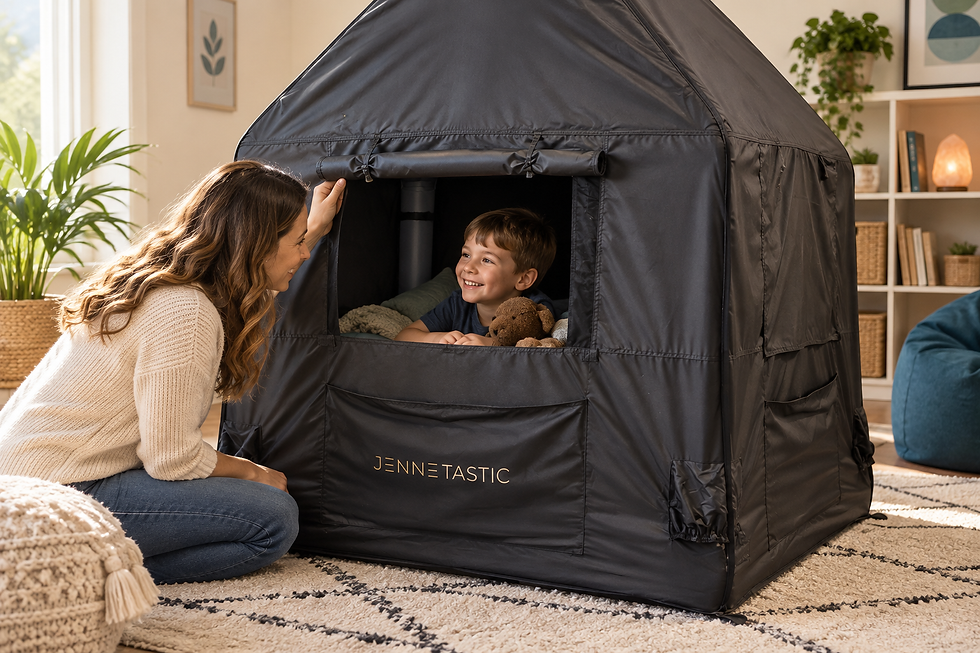
JenneTastic is JenneDesign's inflatable portable sensory tent. The current product information describes an indoor setup with a manual pump, carrying bag and bilingual guide, recommended for children aged three and older with adult supervision. Its home role is a temporary, defined place for a pause. Portability may matter when a family cannot leave a permanent corner assembled or wants a familiar arrangement during visits.
Before choosing it, consider the space where it would stand, who would supervise and whether the child is comfortable with a tent. A product can offer a physical boundary without being the right fit for every preference. A child who wants to see the whole room or dislikes enclosure may prefer an open chair. Choosing that alternative is a useful decision, not a failure to use sensory support.
Fit it into the room before the routine
Measure the intended area and consult the current guide for product dimensions and setup instructions. Allow room for the tent, the opening and a clear route around it. Check the location during the time you expect to use it: an empty living room in the morning may become a busy walkway when everyone returns home. Keep the tent away from heat, stairs and sharp objects.
An adult operates the manual pump and checks that the structure is stable. Keep the entrance and exit clear throughout use, and never use the tent to restrain or prevent a child leaving. It is not a bed or a place for active play. A supervised pause for one child provides a straightforward starting arrangement; any accompanying adult must be able to support safe access and follow the guide.
The JenneTastic family information explains its intended home and visiting use. Review the instructions supplied with your own product, including inspection, cleaning and storage. A feature such as an adjustable opening should be used according to those instructions, not improvised into a claim that the tent can remove all noise or address every sensory need.
Introduce it when there is no urgency
Show the child the tent during a comfortable moment. Let them look from outside, explore the opening or decide to leave it for another day. Offer a familiar activity if they want one. There is no need to persuade them to stay inside for a set duration to prove that the introduction worked. Being able to choose and leave is part of understanding the space.
Keep an open alternative available. The tent should expand the child's options rather than become the only place adults permit a break. You might offer the tent or a nearby reading chair. Watch which arrangement the child actually chooses across different activities. A preference on one day does not commit them to the same setup every time.
For further feature information, explore JenneTastic. This guide does not present the product as a treatment or promise changes in anxiety, attention or behaviour. Its place in a family plan depends on fit, safe use and whether the child finds the arrangement comfortable and useful.
Other home options: match the item to the activity
After considering JenneTastic, compare alternatives by the job they would do. An open reading chair provides a place to sit without enclosure. A basket organizes familiar activities. Comfortable clothing addresses contact with fabric. A stable foot support changes a seating setup. These are different functions, and purchasing one of each does not create a complete or individualized plan by itself.
Use existing household items where suitable. A quiet end of the sofa may already meet the need for a pause. Moving books within reach may solve the problem of repeatedly asking an adult to retrieve them. Choose age-appropriate items that are easy to maintain and do not introduce new hazards. “Sensory” on a label does not remove the need to check construction, fit and instructions.
Compare open space and enclosure
An open corner may suit a child who wants to watch family activity without joining it immediately. It can also make supervision straightforward. Its limitations may include nearby noise or interruptions. Rather than assuming those limitations require a tent, first ask whether positioning the chair differently or changing the television routine would address the main issue.
A defined tent space may appeal to a child who likes a visible boundary. Its usefulness still depends on placement, supervision and the child's willingness to use it. Compare the experience, not the marketing language. Does the child have enough room? Can they comfortably communicate with the adult? Can the opening stay clear? Would they choose this option when a simpler one is available?
Consider small purchases before large ones
For a clothing issue, buying one suitable garment to test may be more sensible than replacing every item. For organizing a routine, a basic basket or a few meaningful picture cards may be sufficient. For background sound, first identify what can be reduced at its source. A specialized product should not be the automatic answer to a household problem that an ordinary adjustment can resolve.
Treat weighted products, suspended equipment and other specialist items as a separate decision requiring appropriate advice. They are not essential accessories for a calm corner. The Royal College of Occupational Therapists' sensory resources include guidance about weighted blankets and professional sensory practice. Discuss suitability and safe use with a qualified professional rather than copying a universal online formula.
Keep receipts, care instructions and return information together. If a product does not fit the intended use, reassess it instead of adding more accessories to justify the purchase. A home support should make daily life more workable. Maintenance, storage and the time needed to supervise are part of its cost, even when the purchase price appears manageable.
Make a shared room workable without renovating

Shared rooms rarely stay quiet all day. Family members cook, talk, work, watch television and play. Planning around that reality is more useful than promising a permanent retreat from every sound. Identify the times when competing activities are hardest to manage and decide which changes the household can reasonably make during those periods.
Try separating activities by location or time. Someone can use headphones for their own entertainment while another person reads, where appropriate. A noisy household task may be moved away from a predictable pause if doing so is practical. These are household agreements, not a demand that everyone remain silent. Explain what the arrangement achieves so that family members understand why it matters.
Work with a small floor plan
In a small home, circulation comes first. Keep access to doors, seating and essential storage. A support area that blocks the route through the room will be difficult to maintain and may create conflict. If a tent or chair must be moved each day, decide where it goes before and after use and who handles the setup. Do not rely on a child to rearrange heavy furniture.
Consider what is visible from the chosen spot. A shelf behind a child may not affect their view, while a busy screen directly ahead may be difficult to ignore. You may only need to move the seat or turn off one device. Storage can help organize a space, but a home does not need to be stripped of colour, family photographs or personality to offer consideration for a child's preferences.
Renters can focus on reversible changes: furniture placement, portable storage, suitable curtains and scheduling household tasks. Check tenancy rules before installing fixtures. An accessible home plan should not depend on owning the property or having a spare room. Write down the space you actually have and choose supports that can function within it.
Let the arrangement change with the day
A child may want a break near a caregiver while dinner is prepared and more privacy while reading later. One fixed location may not serve both activities. Where safe supervision allows, you can offer more than one ordinary option. Predictability can come from how adults explain the pause rather than from demanding that every pause happen in the same exact spot.
Review the arrangement when furniture, routines or household needs change. A place that worked before a sibling became mobile may need reassessment. Seasonal heating, open windows or a new work-from-home schedule can also change the room. Treat the setup as part of a living household, with occasional adjustments rather than an installation that never needs another look.
Support dressing from the wardrobe to the doorway

Dressing combines several tasks: selecting clothes, finding items, managing fastenings, changing position and tolerating fabric against the skin. A difficult morning may involve any of those demands. Separate the questions before deciding what to buy. Can the child put the garment on? Does it fit? Is the problem a seam, temperature, a change from a favourite item or uncertainty about what to wear?
The NHS guidance on dressing sensitive children discusses fabric preferences, seams, labels and the value of trying changes without time pressure. Those are practical possibilities to consider individually, rather than a requirement to select one particular fabric for every child.
Build a small reliable clothing selection
Identify clothes the child already finds comfortable. Notice fit, sleeve length, waistbands and how items feel after washing. Use that information when replacing a garment. Buying the same style in a larger size may be helpful, but check that a manufacturer's material or construction has not changed. A familiar name on the label does not guarantee an identical feel.
Offer a manageable choice between suitable options. A whole wardrobe can be difficult to navigate when time is short. Two outfits appropriate for the day's weather may provide enough choice without an extended search. Keep a backup accessible, particularly when spills or changing weather are likely. The backup should be something the child has already had an opportunity to try.
Check irritating details carefully. If removing a label leaves a rough edge, it may not solve the problem. If socks are the concern, inspect the seam and fit rather than assuming shoes are responsible. Avoid modifying protective or specialist clothing in ways that affect its intended function. For persistent skin discomfort, consider whether irritation, eczema or another issue needs clinical attention.
Separate practice from the morning deadline
A child learning a fastening may need time that a departure routine cannot offer. Practice the skill at another comfortable moment while using a manageable alternative for the morning. This supports learning without making every school day a test. Ask an occupational therapist for activity-specific advice when dressing skills or balance are repeatedly difficult.
Organize the doorway so it does not undo the earlier preparation. Shoes, coat and bag can have consistent places within reach where appropriate. Check whether the child becomes too warm while waiting in outdoor clothing. Letting them put on the final layer closer to leaving may be a practical adjustment, provided supervision and weather needs are met.
In a hypothetical family example, a child comfortably wears a favourite shirt but repeatedly struggles with a new jumper. The caregiver sets the jumper aside, checks its neck seam and offers a familiar layer for the next morning. Later they explore alternatives without a departure deadline. The useful change is specific: addressing the garment rather than treating the whole dressing routine as a behaviour problem.
Make washing and toothbrushing more predictable

Bathrooms bring together sound, temperature, smells, light, touch and changes in body position. Start with the exact step that is uncomfortable. A child who dislikes water reaching their face needs a different discussion from one who cannot reach the tap or fears slipping. Ask what happens during the task and check the physical setup before adding a new routine or tool.
NHS advice on washing sensitive children identifies bathroom acoustics and lighting, preparation, communication and personal preferences as areas to consider. Its suggestions provide possibilities for discussion; they do not establish a single washing method that will suit every family.
Prepare the task before asking the child to begin
Place the needed towel and washing items within the adult's reach before starting. Search time can turn a short routine into an uncertain wait. Explain the next step in simple language and avoid surprising the child with contact. Where they can safely do part of the activity themselves, offer that involvement rather than assuming adults must handle every step.
Check water temperature and follow appropriate supervision for the child's age and needs. A bathroom adaptation must not reduce visibility, introduce electrical hazards or make the floor unsafe. If softer lighting is considered, ensure the adult can still supervise effectively. Keep household products stored appropriately and use them according to their instructions.
Try one preference-related change at a time: a different washcloth, a familiar towel or a less strongly scented product if suitable. Ask which part of the change the child prefers. Do not equate tolerating a brief trial with agreeing to the entire new routine. A child may find one item better while still needing help with another part of washing.
Keep dental care connected to professional guidance
For toothbrushing, distinguish difficulty with the sensation from pain, an unsuitable brush or trouble managing the task. Ask a dental professional about age-appropriate toothpaste, technique and alternatives when brushing remains difficult. The NHS dental strategies for sensitive children offers a starting point for exploring preferences alongside dental advice.
Make the sequence understandable: get the brush ready, brush, rinse or finish as professionally advised, then put items away. Pictures may be helpful if they mean something to the child, but they are not mandatory. Some children prefer a brief spoken explanation. Avoid turning an unfamiliar sound or timer into another demand without checking how it feels to them.
A calm corner can be available before or after a demanding hygiene routine, but it does not replace hygiene or address its specific barrier. If washing repeatedly causes significant distress, seek help developing a workable approach. Do not keep repeating a painful or frightening task unchanged because a sensory product has been added elsewhere in the house.
Consider comfort and participation at mealtimes
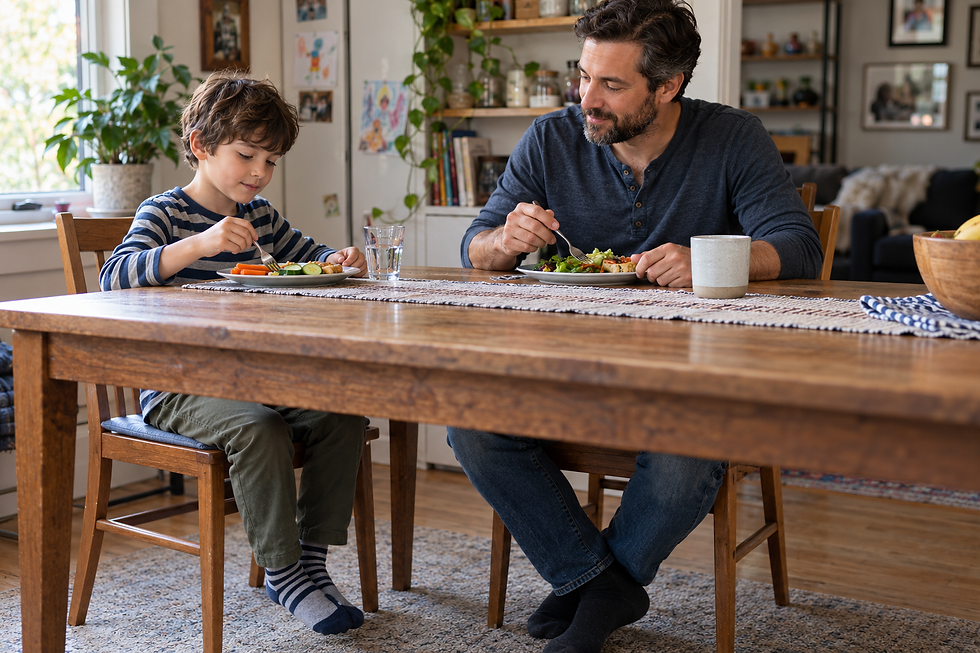
Mealtimes involve far more than taste. A child may be concerned about mixed foods, strong cooking smells, the feeling of cutlery, the chair or an unpredictable conversation. Begin with what you observe and what the child communicates. Avoid assuming that refusing a particular food proves a sensory diagnosis or that one product will solve a feeding difficulty.
The NHS eating strategies for sensitive children discusses adjusting expectations, table setup and preparation. Such guidance can help organize questions about the activity. It should sit alongside individualized assessment when intake, growth, pain or swallowing raises concern.
Check the place at the table
Look at whether the child can comfortably reach the meal and sit with appropriate support. A suitable chair or foot support may address a practical seating problem; it should not be advertised as a guaranteed attention intervention. Check stability and fit. If positioning needs are complex, seek professional advice rather than adapting furniture in a way that may be unsafe.
Consider the setting during an ordinary meal. Is the television playing behind the plate? Does an adult stand over the child asking repeated questions? Is a sibling's activity crowding their place? You may be able to change seating, turn off a competing screen or place shared items elsewhere without changing the food itself.
Use utensils and dishes the child can manage. A non-slip surface may help if the plate repeatedly moves, while a comfortable handle may address a grip difficulty. Those choices have a clear practical purpose. Select items suitable for the child's age and ability, and ask for specialist guidance when ordinary equipment does not meet a physical or feeding need.
Do not make comfort conditional on eating
Avoid withholding a familiar place for a pause until a child has tried a food. Support for discomfort and nutritional planning are different responsibilities. Explain what will happen at the meal and offer reasonable consideration, while following any feeding plan developed with the appropriate professionals. Do not use pressure or public comparison with a sibling to measure success.
Record useful details when you need to discuss a persistent problem: foods currently accepted, what happens with unfamiliar items, coughing or discomfort, and any effect on daily life. A short, factual record is more useful than calling the child picky or assuming they will eat when hungry enough. Bring those observations to the child's health professional.
In a hypothetical example, a family notices that the evening meal becomes harder while the extractor fan, television and several conversations compete. They first turn off the television and move the child's chair away from a speaker. They still address food concerns separately. The example illustrates a household adjustment, not evidence that reducing background sound treats a feeding condition.
Create an arrival routine that leaves room to recover
Coming home can involve a sudden switch from a busy day to questions, clothing changes, snacks and family plans. Consider what your child needs immediately on arrival and what can wait. A predictable sequence may help the household organize that transition without requiring a detailed report about the day at the doorway.
Start with basic needs and practical tasks: put belongings somewhere consistent, use the toilet if needed, have appropriate food or drink, and choose what comes next. The order will depend on the child and family. A pause may fit before conversation or after a snack. Avoid prescribing the same sequence to every child or presenting a fixed duration as necessary for sensory regulation.
Offer a choice that you can actually provide
If an adult is preparing dinner, suggest options compatible with supervision: a nearby reading chair, a suitable quiet activity at the table or a safely placed tent with the adult present. Do not promise private time in another room if nobody can supervise appropriately. Clear choices are more helpful than an attractive option that becomes unavailable when the child selects it.
Consider movement as an ordinary option too. A child may want to walk with a caregiver, play outside where suitable or do a familiar activity before settling. A calm-space plan should not imply that every child needs enclosure or sitting still after a busy day. Ask what feels workable and adapt within the family's circumstances.
Keep conversation flexible. “I'm here if you want to tell me something” can leave an opening without demanding a full account immediately. Some children prefer discussing their day while doing another activity. If there is an urgent issue to address, use clear, manageable questions and the child's usual communication supports.
Plan the next step before it becomes a surprise
Explain the activity that will follow the pause. If dinner or an appointment is approaching, give information the child can understand rather than relying on an unexplained countdown. A picture, a familiar household cue or a brief verbal reminder may be appropriate. Ask whether timers help or create extra pressure; their usefulness is individual.
A pause can end with a supported transition rather than an abrupt instruction to leave. Offer help putting a book away, locating the next item or moving to the table. If the child remains uncomfortable, reconsider the next demand and whether another need is involved. Longer or repeated difficulty deserves attention to the whole routine, not simply a longer period in the calm space.
On days when arrival is unexpectedly different, name the change. A visitor, delayed meal or new caregiver can alter the plan. Predictability does not require a life without surprises; it can mean an adult explains what has changed and helps the child understand their options. Keep the explanation brief enough to be useful in the moment.
Use visual routines where they improve understanding

A visual routine makes useful information available to look at again. It can show where an activity happens, what comes next or which choices are available. It does not have to be a professionally printed chart. A few pictures, familiar objects or words may be enough, depending on the child's communication and reading skills.
NICE's guidance for autistic children and young people recommends considering meaningful visual supports, personal space and individual sensitivities in the environment. Its scope is autism care; it is not proof that any particular household chart or tent works for every child. The principle is relevant to planning: choose information the child understands instead of assuming a standard icon has a universal meaning.
Keep the display as simple as its job
If the problem is uncertainty about the next activity, show the current activity and the next one. A full day displayed at once may provide more information than the child needs. If finding belongings is difficult, a picture on the correct basket may be more useful than a schedule. Define the information gap before choosing the format.
Use the routine with the child. Point out the relevant step, explain it and make any changes visible. A chart left on the wall does not automatically become understandable. Check whether the child uses it, asks about it or prefers a different explanation. If it becomes another object adults repeatedly instruct them to consult, the format may need adjustment.
Include a way to communicate help, finished, stop or a change of preference where relevant. A support that only tells the child what adults want next leaves out their part in the conversation. Keep their established communication system accessible in the calm space and throughout routines. Do not replace a familiar communication device with a homemade chart without appropriate advice.
Make changes honest and visible
When plans change, update the display rather than leaving the old activity in place. Explain what is happening and offer a choice where one exists. A visual plan loses usefulness if adults treat it as accurate while routinely doing something else. The goal is reliable information, not completing every icon regardless of circumstances.
Give older children a say in presentation. They may prefer a discreet list on their own device or a simple written note instead of illustrated cards displayed for visitors. A useful support should respect age, privacy and preference. Ask what makes it convenient to use at home, particularly when siblings or guests will see it.
For the underlying recommendation, see NICE guideline CG170 on environmental adjustments. The household examples here are planning suggestions rather than a prescribed intervention. Where communication needs are complex, consult the professionals already supporting the child so that home routines remain compatible with their established approach.
Balance quiet activities, movement and ordinary play
Home support should leave room for enjoyment. A child does not need to spend every free moment practising a coping skill or using an item adults consider therapeutic. Ask which activities they actually choose: building, drawing, reading, music, outdoor play or spending time with someone. Start from those interests when arranging accessible options.
Think about the setting for each activity. Drawing may be easier at a stable surface with materials within reach. Building may need a place where the work will not immediately be knocked over. Reading may be more comfortable away from a screen. These are ordinary participation questions that help families decide what to organize without turning play into a clinical programme.
Make movement possible in suitable places
A quiet area and an active play area serve different purposes. Keep active play outside a tent intended for temporary calming use. In a small home, the distinction can be made through timing rather than separate rooms: clear the floor for a familiar movement game, then put equipment away before another activity. Adults remain responsible for checking suitability and supervision.
Do not introduce climbing, suspended swings, spinning equipment or challenging exercises solely because they appear in an online sensory routine. Such activities may require individual assessment, installation checks and specific safety guidance. Ordinary opportunities to move can be considered without assigning a therapeutic dose or claiming a neurological effect.
If a professional has recommended an activity, ask how it should fit the home. Where should it happen? What equipment and supervision are required? What signals mean stop? How should the plan be reviewed? Instructions that work in a clinic may need practical adjustment for a small apartment or a caregiver supporting several children.
Keep choice within play
For tactile activities, allow a child to use a tool, watch or select a different material when appropriate. Touching every texture is not a necessary measure of a successful afternoon. Check materials for age suitability, allergies and small-part risks. Store them so that a younger sibling cannot access unsuitable items when the intended activity is over.
Offer a manageable selection rather than filling every surface. A child may find it easier to choose between two familiar activities than search a large mixed bin. Rotate items when useful, but do not remove a reliable favourite merely to force variety. The reason for changing a selection should be practical: interest, access, maintenance or a new activity the child wants to try.
Watch whether adults have accidentally made every preferred activity into a reward for tolerating something uncomfortable. Families can set reasonable routines while keeping ordinary enjoyment available. Support works best when it helps the child participate in daily life, including the parts that are fun, rather than creating an endless series of tasks to complete before play is allowed.
Respect siblings, pets and other household needs

A home plan needs to work for more than one person. Siblings may want company, have their own sensory preferences or need help understanding why a routine changes. Explain the arrangement in concrete terms without disclosing private medical information: everyone sometimes needs space, and family members can ask for different forms of help.
Avoid appointing a sibling as the supervisor or making them responsible for preventing distress. Adults should manage product setup, safety and agreements. A sibling can participate in a family routine voluntarily, but should not be expected to monitor another child's use of a calm space or give up all their own activities indefinitely.
Agree on shared-space boundaries
Discuss how to ask before joining, where noisy play happens and how to keep entrances clear. Make the rules understandable and apply them consistently. If a younger child cannot yet follow them, supervision and physical organization need to account for that. A spoken rule alone is not a reliable safety arrangement for a toddler who is curious about a tent or basket.
Keep age-inappropriate items away from younger children. A fidget suitable for an older child may have small parts. A reading area may contain possessions a sibling should not handle. Use storage appropriate to the actual household rather than relying on the fact that an item belongs to someone else. Check after activities are finished, not only before they begin.
Pets can change how a space feels and functions. Some children enjoy an animal nearby; others want distance. Keep the doorway and floor route clear, and do not expect an animal to respect a child's preferred boundary without adult management. A tent is not a place to confine a pet with a child. Consider the needs and safety of both.
Make fairness understandable
Fairness does not always mean identical equipment or identical routines. One child may need a quieter place for reading while another prefers to move. Explain the purpose of an adjustment rather than comparing needs or describing one child as the reason everybody loses something. Where possible, give each family member a way to request consideration.
Plan time when siblings can enjoy each other's company without making participation compulsory. Separate activities can coexist in a shared room when boundaries and supervision work. A break does not have to cancel the rest of family life. If conflict repeatedly surrounds the setup, revisit placement and expectations before assuming the child should use the space more independently.
Caregivers' needs matter too. A parent who is cooking, working or caring for another child has practical limits. Choose an arrangement that can be supervised and maintained within those limits, and seek support when the daily load is unmanageable. An ambitious home plan should not depend on one adult being available everywhere at once.
Make homework accessible without turning home into another classroom
Homework brings several demands together: understanding an instruction, remembering materials, sitting or moving comfortably, handling writing tools and managing the effort of a school day. A child struggling to begin may need clarification, rest or help with a skill rather than another sensory accessory. Start by asking what the task requires and which part feels difficult. Keep school curriculum and classroom accommodations in conversation with the teacher; the home plan should make the agreed task more manageable.
Prepare a workable place and a clear starting point
A homework space does not need to be a permanent desk or a perfectly quiet room. Try a cleared end of the kitchen table, comfortable seating and the materials needed for one task. Check whether glare, a nearby television or people passing behind the chair are distracting for this child. Offer a choice between two realistic places when possible. Avoid placing the child inside a tent with a task if they use that tent as a voluntary rest space; preserving its purpose may matter more than making it another work station.
Read the instruction together and identify the first action: open the book, find the page or complete one example. Keep the remaining materials nearby rather than spreading every worksheet across the table. If writing itself is difficult, describe that difficulty to the teacher and ask what response format is appropriate. An adult can help organize the task without silently completing it for the child or assuming that a sensory explanation accounts for every learning challenge.
Agree on pauses and know when to stop
Discuss a workable pause before the task starts. Some children prefer a brief walk, a drink of water or quiet time; others prefer to finish a small piece before changing activities. Use a timer only if it helps the child understand the plan. A ticking sound or countdown can add pressure for some children. Movement, flexible seating and a familiar object are options to try according to preference, not guarantees of better attention or marks.
Record the practical result: whether the child understood the work, how much help was needed and whether the plan was comfortable enough to repeat. If homework repeatedly consumes the evening or produces significant distress, share that pattern with the teacher instead of continually extending the session. Ask about priorities, expected time and suitable adjustments. The aim is participation in learning alongside family life, meals and rest; a home support plan should leave room for all of them.
Keep the evening pause separate from sleep
Evenings often combine tiredness, unfinished tasks and changing expectations. Consider which activities genuinely need to happen before bed and which can be prepared earlier. Locating clothes, packing a bag or choosing tomorrow's book does not have to compete with the final part of the bedtime routine. Reducing that practical scramble can make the evening easier to organize.
Offer a familiar, appropriate quiet activity if the child wants it. That might be reading with an adult, drawing or sitting in an ordinary comfortable place. A supervised JenneTastic pause, where suitable, remains distinct from sleep: the tent is not intended as a sleeping space. Move to the child's usual appropriate sleep arrangement rather than leaving them in the tent after they become sleepy.
Review the actual bedtime setting
Ask about the child's ordinary preferences for bedding, clothing, light and background sound. Avoid assuming that a darker room, a scented product or a sound machine is necessary because it appears on a sensory shopping list. A new item may add another sensation the child dislikes. Check any lighting or electrical equipment for safe placement and follow its instructions.
The Canadian Paediatric Society's healthy sleep information for families emphasizes the importance of sleep and healthy sleep habits. Persistent sleep concerns deserve attention to the child's overall situation. A calm-space product is not a substitute for discussing ongoing difficulty, unusual sleepiness or other concerns with the child's health professional.
Keep the final routine understandable. If two caregivers handle different nights, agree on the essential steps while allowing ordinary differences in how they read a story or offer company. Consistency does not require identical words from every adult. It means the child receives reliable information about what happens and who is available to help.
Do not measure an evening plan only by how quickly the child becomes silent. Consider whether the routine is comfortable, whether needs are communicated and whether the household can maintain it. A plan that requires increasingly elaborate accessories each week may need simplification. Start by revisiting the particular difficulty rather than extending a collection of bedtime products.
Carry a workable routine to family visits
Visiting relatives can change sounds, smells, available space and expectations. Prepare with the host rather than expecting the child to tolerate every difference without support. Ask where a supervised pause could happen, what the room is like and whether there are hazards or pets to consider. A familiar item can help maintain a routine, but it does not make an unfamiliar environment identical to home.
If you plan to bring JenneTastic, confirm that there is a suitable indoor area and an adult available to supervise. Take the instructions with the product. Portability concerns transport; safe use still depends on the destination. Do not set it up in a hallway, near a heater or somewhere the responsible adult cannot remain nearby simply because it fits into that space.
Tell the host what is useful
Share a few concrete requests: allow a pause from conversation, avoid crowding the child, keep the route clear or explain a planned activity before it starts. A host does not need a long account of diagnostic history to help with those details. Discuss private information with care and include the child in deciding what is shared when appropriate.
Explain the visit to the child in a form they understand. Who will be there? Where can they ask for help? What can they bring? If the plan may change, acknowledge that rather than promising certainty you cannot provide. Keep a realistic way to leave or shorten the visit when the family needs it, without presenting departure as punishment.
Prepare a simple backup
An ordinary chair beside the caregiver may be the better option if the intended room is unavailable. A familiar book or quiet activity can travel without a full sensory setup. Decide what is essential for the visit and what is optional. This makes it easier to adapt when a host's floor plan or plans differ from what you expected.
Afterwards, ask about one or two useful details rather than conducting a lengthy performance review. Perhaps the child preferred sitting near a parent, wanted fewer greetings at once or enjoyed a particular activity. Use that information next time. A visit can be worthwhile even when it is brief or organized differently from another family's gathering.
Spend where there is a clear reason
Set a budget after identifying the activity you want to improve. Separate changes requiring no purchase, small everyday items and larger products. Rearranging a chair or changing when the vacuum runs belongs in the first group. A suitable clothing replacement or storage basket belongs in another. A portable tent requires a fuller decision about placement, supervision and use.
Consider recurring costs and effort. An item needing frequent batteries, replacement parts or extensive cleaning may be harder to maintain than its initial price suggests. A product that must be assembled during the busiest part of the day may not fit the routine. Include storage space and caregiver time in the comparison, not only the advertised discount.
Ask purchasing questions in ordinary language
What problem would this address? What would we use if we did not buy it? Can the child try a comparable arrangement first? Does it fit the room and the child's abilities? Who will clean, inspect and store it? These questions can prevent a collection of well-intentioned purchases that do not serve a clear purpose.
Read the current product details before ordering. Check the included items, instructions, age recommendations, shipping and return terms. Avoid relying on an old social post or another family's experience to establish today's price or policy. For specialist equipment, discuss the proposed use with the appropriate professional before making a purchase that may be unsuitable.
Compare products without treating cost as proof
An expensive item is not automatically more effective, and a simple household adjustment is not automatically sufficient. The right comparison is whether the option meets the identified need safely and practically. A portable tent may be worth considering when portability and a defined space matter; it may be unnecessary when a child prefers an available chair.
Keep a short purchasing note for larger items, including the reason for choosing them and any instructions received. Revisit that reason after ordinary use. If the product is rarely chosen, ask why before buying something to accompany it. The child may prefer another arrangement, the location may be inconvenient or the original need may have changed.
Review support without turning home into a clinic

Families need enough information to make decisions, not an elaborate daily scoring system. Choose a few indicators connected to the original goal. For dressing, that might be whether the child finds suitable clothes and reports comfort. For a pause, it might be whether they can access the space, communicate with the adult and move on with appropriate support.
Ask the child what matters to them. An adult may value a quicker routine while the child values not being surprised by contact or having time to choose. Both perspectives can inform the plan. Where verbal answers are difficult, use familiar pictures, gestures or the established communication system. Do not interpret the absence of an objection as proof of comfort.
Record context instead of declaring cause
Note what changed and what else was different that day. A quieter meal may also have happened earlier, with a different caregiver or after better sleep. An improvement does not prove that a single item caused it. You can still keep a practical adjustment that the family finds useful while being honest about what the observation can and cannot show.
Avoid repeated testing when a child clearly finds something uncomfortable. You do not need to collect a full week's data before stopping an unsuitable setup. Remove the immediate problem, offer an appropriate alternative and seek advice if needed. Reviewing support should help protect comfort and participation, not justify persisting with a purchase.
Decide what to keep, change or stop
Keep arrangements that fit the goal and are manageable. Change details when access, timing or upkeep gets in the way. Stop items that are damaged, unsuitable or consistently unwanted. A product can be stored for another appropriate time without requiring continued use now. These decisions are part of responsible planning rather than evidence that the family has failed.
Choose a review moment that does not interrupt the routine itself. A brief conversation between caregivers after the child is settled may be enough. If observations are being shared with a professional, use a concise summary. Keep the child's privacy in mind and avoid distributing videos or detailed records more widely than necessary.
Bring specific questions to professional support
Seek professional input when daily activities remain significantly difficult, concerns are persistent or changes raise questions about health and development. A household observation cannot establish a diagnosis. Pain, marked feeding problems, loss of skills or sudden changes should not be explained away as sensory preferences. Start with the child's usual health professional and follow their guidance about appropriate assessment.
An occupational therapist can help examine participation in activities such as dressing, washing and managing the home environment. Ask about the actual task rather than requesting a generic list of sensory products. A useful consultation connects the child's abilities, preferences, environment and family circumstances to an understandable plan.
Prepare a concise account
Bring the routine that matters most, a few examples and the adjustments already tried. Include what the child enjoys or manages comfortably. Explain practical limits: room size, other children, caregiver availability and budget. A plan that ignores those circumstances may be difficult to use, however promising it sounds in a consultation.
Ask what each recommendation is intended to change and how you will know whether it helps. Request clear instructions for specialist equipment, including supervision, maintenance and when to stop. If a suggested activity appears to conflict with the manufacturer's directions, ask for clarification before using it. Professional input and product instructions should both be taken seriously.
Agree on the next step
You should leave knowing what to do first, what can wait and when to return for review. If the plan contains several changes, ask which has priority. It may be more manageable to start with one daily task than apply an extensive programme across the whole home. Clarify whom to contact if difficulties continue or the recommendation does not fit.
Support can remain respectful while assessment is underway. Offer reasonable comfort, clear information and help with activities. Do not require a diagnostic label before listening to a child's description of discomfort. At the same time, keep seeking appropriate input when the concern is more than a manageable preference or when ordinary adjustments have not addressed it.
A practical plan for the next two weeks

Use the following sequence as a planning framework, not a treatment schedule. It does not prescribe how long a child should use a tent, how often they need a break or which sensory activities they require. The purpose is to give the adults enough structure to make one household change thoughtfully and review it.
First: choose and prepare
Choose one routine and describe the difficulty in a sentence. Ask the child about the experience where possible. Walk through the room and identify the practical barriers. Select one suitable change, agree who is responsible and prepare any items before the busy part of the day. Make sure the alternative is available if the child does not want the new arrangement.
For example, a family might focus on the first fifteen minutes after coming home. They decide to keep belongings in one place and offer a nearby reading option before a longer conversation. This is a hypothetical organization plan, not a prescribed recovery period. Another family may choose a clothing adjustment instead because dressing is their immediate priority.
Next: try it during ordinary life
Introduce the change without making it a test the child must pass. Explain what is available, provide needed help and notice the experience. If an item is uncomfortable or unsafe, stop using it. Keep notes short: what happened, what the child communicated and whether the activity became more workable. Include unexpected differences that may have affected the day.
Do not introduce several new purchases simply because the first week feels busy. Give yourself time to understand the one change unless there is a reason to adjust sooner. Caregivers can share a brief explanation so the child does not receive conflicting instructions. The essential information is what the support is for and how to use it respectfully.
Then: review and choose the next priority
At a convenient point, consider whether to keep, adjust or stop the change. Check the child's experience and the adults' ability to sustain it. If it has helped, decide whether another routine needs attention. If the concern persists, use your observations to seek appropriate advice. There is no requirement to complete a particular number of adjustments before asking for help.
Before adding an item, check the household basics: a suitable place, clear access, appropriate supervision, understandable instructions and realistic maintenance. A calm space is useful only when those details work together. Let the next purchase follow a specific need rather than the feeling that a sensory-friendly home must continually acquire more equipment.
Home setup checklist
Identify the daily activity you want to make easier.
Ask what the child finds comfortable and what they want to change.
Check the location, access route and required supervision.
Choose a suitable adjustment or item with a clear purpose.
Keep an appropriate alternative and communication support available.
Read product instructions and plan inspection, cleaning and storage.
Review the child's experience and seek professional advice when needed.
Questions families often ask
Do we need a dedicated sensory room?
No. A family's first task is to make the relevant activity more accessible, which may involve a chair, a clothing change or clearer information. A dedicated room is one possible arrangement, not a requirement. Choose a space the responsible adult can supervise and the household can maintain. A small, practical adjustment may address the immediate need without renovation.
What if my child does not want a tent?
Offer an open alternative and listen to the preference. Do not require use to justify the purchase or interpret refusal as unwillingness to accept help. A child may enjoy a defined corner, quiet company or a different activity. Revisit the original goal and choose the arrangement that serves it, with professional input if the difficulty remains significant.
How long should a home pause last?
There is no universal duration established by this guide. Consider the child's needs, the activity, product directions and any individual professional plan. Explain what comes next and provide support for the transition. A timer may help some children and create pressure for others. Persistent difficulty returning to activities calls for reviewing the whole situation, not simply extending time in a tent.
Can a calm space replace changing the rest of the room?
A separate space does not remove the need to address a preventable problem at its source. If the television is unnecessarily loud during a meal, consider the television routine. If clothes are uncomfortable, consider the clothes. A pause can be one option within a wider home plan, while everyday activities remain as workable and welcoming as possible.
Should siblings use exactly the same supports?
Their needs and preferences may differ. Explain the purpose of each arrangement and give everyone a way to ask for consideration. Adults remain responsible for safety and supervision. Sharing ordinary reading or quiet activities may be welcome, but do not assume a child's personal pause should become group play or make siblings responsible for managing it.
Does helpful home support prove a sensory diagnosis?
No. An adjustment can be useful without identifying why an activity was difficult. A change in timing, clothing or communication may address several possible concerns. Use observations to guide practical decisions and discuss persistent difficulties with qualified professionals. Avoid drawing diagnostic conclusions from a purchase, an online checklist or a child's preference for one kind of space.
Build a home plan that fits your family
Choose a starting point you can act on: one difficult routine, one useful adjustment and one clear way for your child to ask for help. Keep the arrangement connected to everyday participation. A calmer home is built through attentive decisions about space, communication, comfort and support, not through a requirement to buy every item carrying a sensory label.
If a portable, defined space would suit your child and home, view the JenneTastic set and current ordering information. Check placement, supervision and the instructions before purchasing. If you need help understanding product setup or included items, contact JenneDesign. Individual health, developmental and treatment questions belong with the appropriate qualified professional.
Sources and further reading
This guide draws on the JenneTastic user guide and current product information for product details; NHS occupational-therapy information for practical dressing, washing, toothbrushing and mealtime considerations; NICE guideline CG170 for its recommendations about environmental adjustments in autism care; Canadian Paediatric Society guidance for sleep information; and Royal College of Occupational Therapists resources for professional sensory practice. These sources are linked at their relevant points above. The household planning examples are illustrative suggestions, not clinical trials or reports of product effectiveness.
Comments